“9 in 10 saw smoother skin.” A line like that is easy to write and just as easy to read past. The number is not the problem. The problem is that there is nothing to check: nine out of how many, measured how, by whom, after how long?
A result becomes believable when a skeptical reader can see where it came from. This guide covers what to publish next to a result, where to put it on the page, and how to keep each result attached to the right product. The example figure above is invented, and so is every example below.
Know which kind of result you have
“Tested” covers very different things, and shoppers can tell when they are blurred together. Sort what you have before you write anything:
- Instrument or expert measurements. Something was measured on skin under a set method, such as hydration readings, or grading by a trained assessor.
- Consumer studies. People used the product and answered questions about what they noticed. This is a real and useful result, but it is a report of perception, not a measurement.
- Ingredient studies. Research on an ingredient, often from its supplier, usually at a set concentration. It describes the ingredient, not your finished product.
- Certificates and standards. A certification or a quality standard is a document, not a test result, and belongs beside the results rather than mixed into them.
Also note who ran each one. An independent lab and your own team are both legitimate, but they are not the same thing, and the page should say which it was. Presenting in-house testing as independent verification is the kind of mistake a brand does not get to make twice.
Publish the details a skeptic looks for
For each result, give the reader these five things:
- What was tested. The finished product, in the formula you sell now, or a single ingredient.
- Who took part. How many people, and anything relevant about them, such as skin type or age range.
- How long, and how it was used. “Twice daily for four weeks” changes what a result means.
- How it was measured, and by whom. Instrument, expert grading or self-assessment, and the name or type of organization that ran it.
- When, and where to read more. The date of the study and a link to a summary a customer is meant to read.
Then write the claim in the same terms as the result. If 27 of 30 people agreed their skin felt smoother after four weeks, say that. Do not turn it into “clinically proven to smooth skin”, which claims more than the study showed.
If you cannot supply one of the five, leave it out rather than fill the gap with something vague.
Put the headline near the claim and the detail one tap away
Shoppers scan before they read, so the layout has two jobs.
Near the top of the page, state the result once, briefly, next to the benefit it supports. One line is enough.
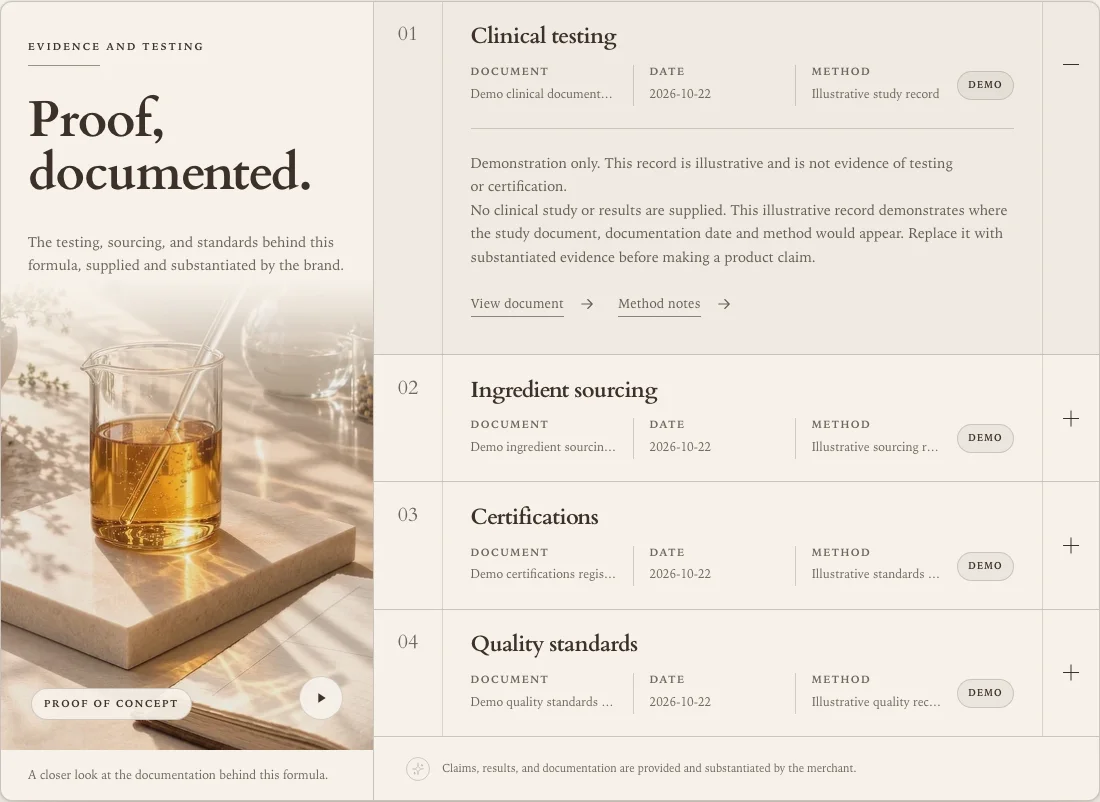
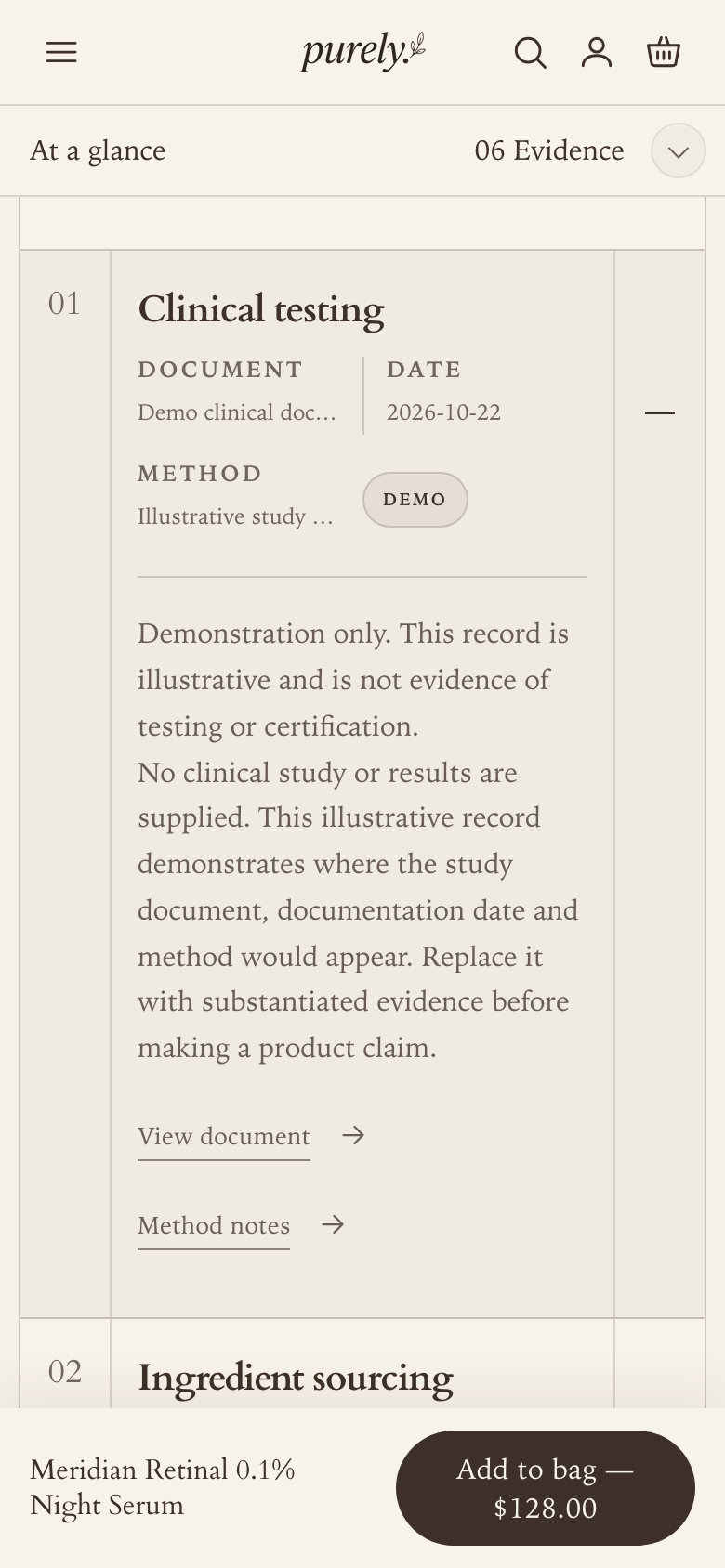
Further down, give the evidence its own section, with one row per record. Each row should show at a glance what the document is, its date and the method. Opening a row should give the explanation in plain words and the links to the document itself.
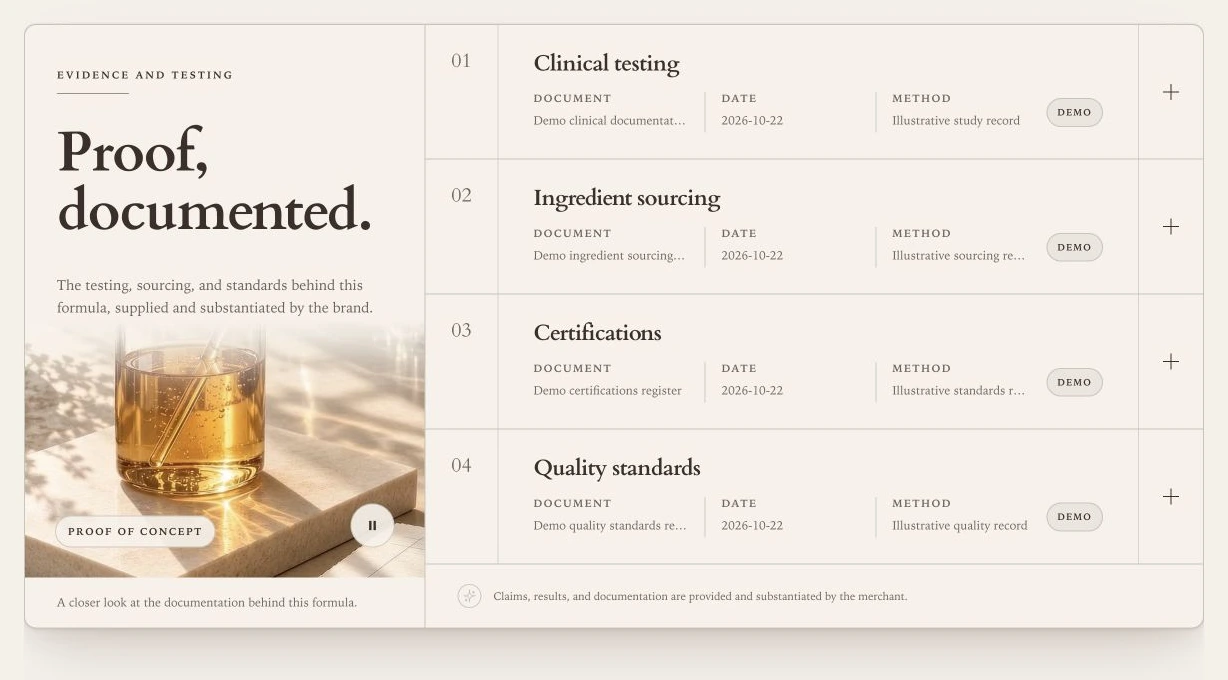
Three things to avoid:
- Results inside an image. Text baked into a graphic cannot be read by a screen reader, found by a search engine or translated.
- A PDF as the only source. Link the document, but put the main facts on the page as well.
- Everything collapsed. If the claim near the top has no visible support anywhere, hiding all of it behind closed panels reads as hiding it.
Keep each result attached to the right product
A common way to get this wrong is technical, not editorial. The result is typed into the product page template, and the template is shared. Now the hydration study for one moisturizer appears under every product that uses that template, including products that were never tested.
Results belong to products, so store them with the product. In Shopify that means structured data on the product itself, such as metafields or metaobject entries, which the theme then reads. A product with a study shows it. A product without one shows nothing.
Milestone, the theme we make, handles this with a section called Proof ledger. Each document is saved once as a record holding its name, date, method, explanation and links. You then pick the records that apply on each product. Rows with nothing to show are hidden, and a product with no records selected shows no ledger at all.
Whatever theme you use, test this before launch: open a product you know has no test results and confirm the page claims nothing.
Show nothing rather than something vague
A proof section is only worth having if you have real documents. Three specific records do more for trust than ten loose ones, and an evidence section padded with “dermatologist approved” and “lab tested”, with nothing behind either phrase, invites the doubt it was meant to remove.
The same goes for sample content. If your theme arrives with example studies or placeholder certificates, remove them or make sure they are unmistakably labelled as examples until your own are in place.
Treat before-and-after photos as evidence
A before-and-after pair is a test result in picture form, and the same rules apply:
- Same person, same framing, same lighting, same crop. If the lighting changed, it is not a comparison.
- No retouching, and no makeup in one image but not the other.
- A caption that states the facts: how long, how often, and what else was used.
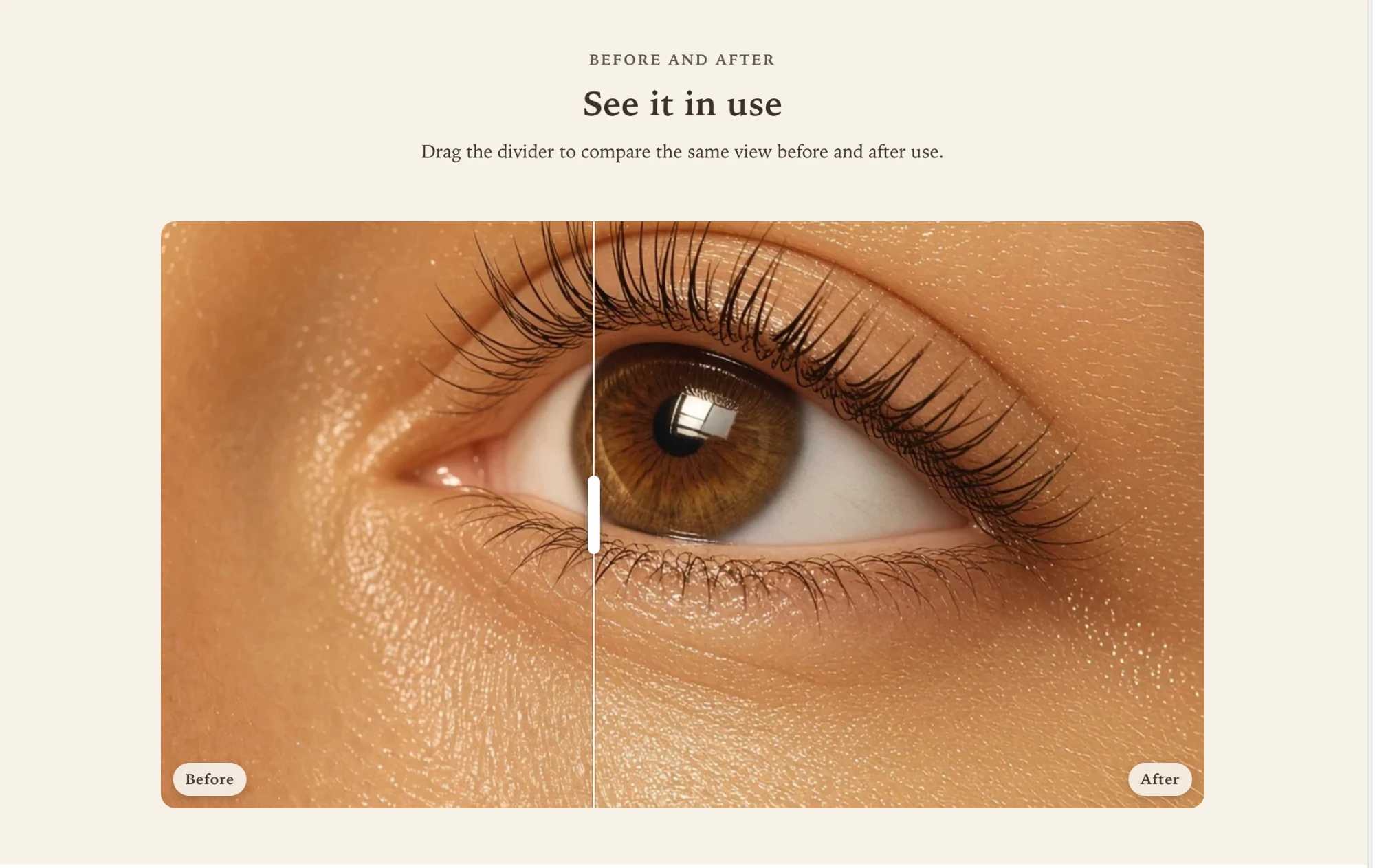
If you use an interactive slider, check that it works with a keyboard as well as a mouse or a finger. Not all of them do.
Check the rules before you publish
This is not legal advice, and a theme studio is the wrong place to get it. What we can say is that rules on cosmetic claims exist, they differ between countries, and both the wording of a claim and the evidence behind it can matter. Two starting points:
- In the United States, the FDA explains how a product’s claims affect whether it is treated as a cosmetic, a drug, or both.
- In the European Union, the Commission’s cosmetics legislation page lists Commission Regulation (EU) No 655/2013, which sets common criteria for claims about cosmetic products.
If you sell into several markets, have someone qualified review your claims for each one.
Before you publish
- Is each result labelled for what it is: measurement, consumer study, ingredient study or certificate?
- Does each one state what was tested, on whom, for how long, how it was measured and by whom?
- Does the wording of the claim match the wording of the result?
- Are the main facts on the page as text, with the document linked?
- Does a product with no results show no results?
- Is every example or placeholder gone?
- Have your claims been reviewed for the countries you sell in?
Ask a question about this article
There is no comment thread here. Send your question and a person will reply by email.